
RTS-012L
Real-Time IoT Power Meter
Key Specifications
- Monitors up to 12 channels (36 current inputs, 3-phase configuration) from a single unit
- Built-in LTE module for automated, real-time data transmission to a central server
- On-site data check via the front touchscreen, or remote access through the web platform
The RTS-012L is an IoT power meter built for real-time power load monitoring. It measures voltage and other electrical values, stores them according to the customer's requirements, and transmits that data to a server over LTE. On the server side, a platform provides dashboard functionality — querying and storing statistics together with each device's real-time status — and administrators can remotely change the meter's instrumentation values and manage key device data.
The meter is intended for installation in feeder pillars and compact substations (CSUs) as an LTE-connected unit; the reference deployment for this design is Malaysia's TNB (Tenaga Nasional Berhad). In that kind of real-time energy management setup, metadata is collected, parsed, and stored on the device, then transferred to the national energy center's server over 4G/LTE. Because the device's status can be checked and its settings adjusted remotely from headquarters, the center does not need to dispatch an engineer to the site for routine checks or configuration changes.
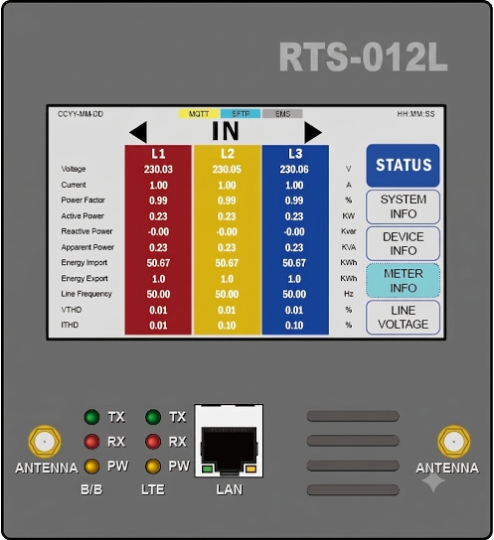
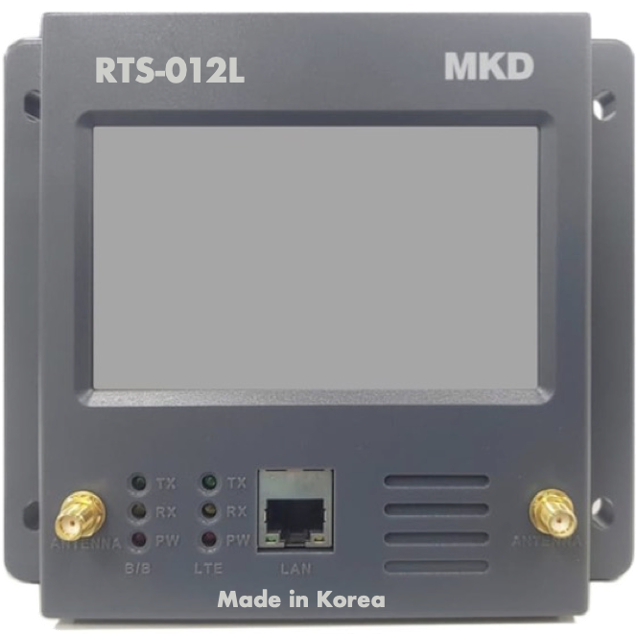
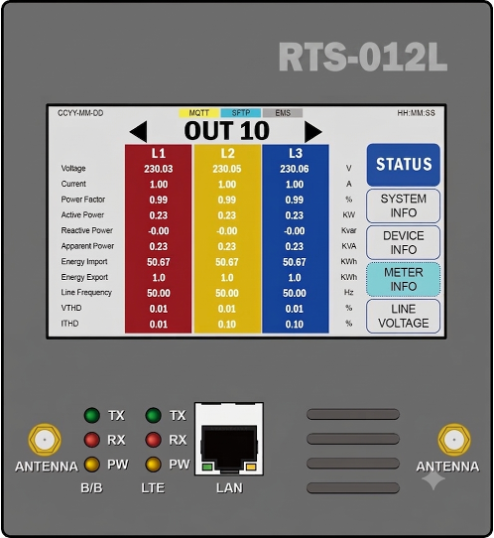
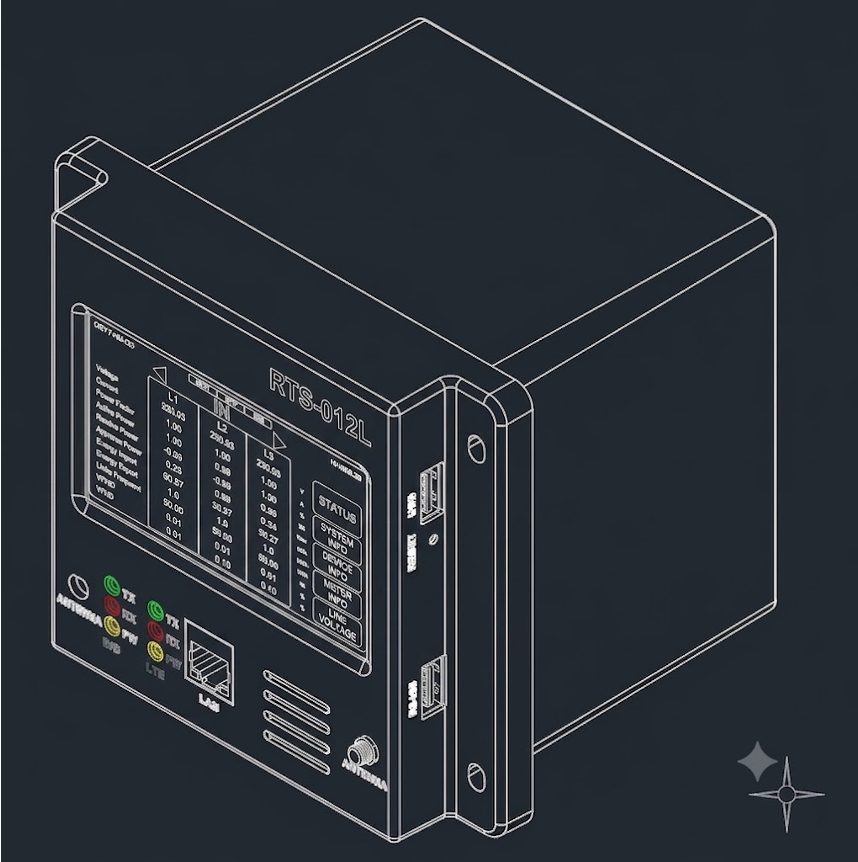
The unit was designed with on-site workers in mind: every interface — LAN, RS485/RS232, and a USIM slot — sits on the front of the machine for quick, easy connectivity, and a 4.3-inch backlit touchscreen lets a technician set parameters and check data on-site without extra tools. Status LEDs on the front indicate the device's connection state and the LTE module's working status. On the rear side, the unit supports monitoring of up to 12 channels, giving a comprehensive read of power load and performance across multiple points from a single meter.
Internally, real-time load monitoring is built on CT (Current Transformer) and PT (Potential Transformer) connections: four current boards (META #1–4) measure the current on each phase, while a 3-phase voltage board measures all three phases via a PT connection. From these inputs the device measures voltage, current, power, energy, frequency, and power factor, and tracks max/min/average values for each. Measurements are written to a CSV file and stored in the device's own memory every 10 minutes, and the same data is sent on to the server for further analysis according to the administrator's policy.
Once an LTE SIM is inserted, the device automatically transmits its initial settings to the server, where the information is stored in the database for the administrator to manage from the web screen — including registering, modifying, deleting, or re-registering devices, with bulk registration available when many units need to be onboarded at once. The same web screen supports remote meta setting, so if a field engineer's on-site setting was wrong, or a policy change requires an update, the administrator can correct it remotely without sending anyone back out to the site.
Interfaces & Display
- 4.3" backlit touchscreen, 480×272 resolution, RGB 40-pin — for on-site setup and live readings
- LAN 10/100Mbps, RS485 ×1, RS232 UART ×1, USIM slot, and I2C — all on the front panel
- Status LEDs for device connection state and LTE module working status
- IoT output: 4–20mA / dry contact (HH, H, L, LL); IoT input: 0–5V, 1 digital input
- 36 current inputs across a 3-phase, 12-channel configuration
Measurement & Accuracy
- Phase voltage (V1,V2,V3) & line voltage (V12,V23,V31): ±0.5% of reading
- Current (I1,I2,I3): ±0.5% of reading
- Total & phase active power (W, W1–W3): Class 0.5 per IEC 62053-22
- Total & phase reactive power (Var, Var1–Var3): Class 1.0 per IEC 62053-24
- Total & phase apparent power (VA, VA1–VA3): Class 0.5 per IEC 62053-22
- Active energy (Wh) and reverse active energy: Class 0.5 per IEC 62053-22 — shown on-device as Energy Import / Energy Export
- Reactive energy (Varh) and reverse reactive energy: Class 1.0 per IEC 62053-24
- Frequency: ±0.02Hz · Total & phase power factor: ±(0.5% of reading + 1°)
- Max/min/average tracking for phase & line voltage, current, and active/reactive/apparent power
Energy Metering (Power Quality)
- 3-phase energy and power quality monitoring — Class 1, Class 0.5, and Class 0.2 meters supported
- Watt accuracy: 0.1% error at 5000:1, 0.2% error at 10000:1
- Voltage reference drift ±25ppm/°C max, with multipoint CT phase/gain compensation
- Low power consumption (15mA); operating temperature range −40°C to +85°C
- Power quality: half-cycle RMS refresh (VRMS½/IRMS½), 10-cycle/12-cycle RMS, dip & swell monitoring, per-phase line frequency, zero-crossing & timeout detection, phase angle measurement
- Metrology: total & fundamental active power, VAR, VA, watthour, VARhour, VAhour, total & fundamental IRMS/VRMS, THD, power factor
- Standards: IEC 61000-4-30 Class S; active energy per IEC 62053-21/22, EN 50470-3, OIML R46, ANSI C12.20; reactive energy per IEC 62053-23/24
- High-speed communication port: 20MHz SPI
System & Communication
- Processor: Cortex-A7 1.2GHz (ARMv7)
- Memory/storage: SPI NOR Flash 256Mbit, SDRAM 64MB DDR2, 8GB eMMC (NAND flash)
- LTE module (Mini-PCIe form factor): LTE FDD B1/B3/B5/B7/B8/B20, LTE TDD B38/B40/B41, WCDMA B1/B5/B8, GSM B3/B8
- LTE module power: 3.0–3.6V supply, 30mA @ idle / 3.9mA @ sleep; module size 30.0×51.0×4.9mm, 9.8g
- Device power: DC 12V ±5%, 2A input, 24W max consumption
- Device dimensions: 120mm × 120mm × 30mm
- CSV data logging every 10 minutes with policy-based server upload
- Transmits to the center via the EMS platform, or directly over MQTT / SFTP
- Device auto-reset and firmware auto-update functions for reduced maintenance visits
Certifications
- Global: GCF · Europe: CE · South Korea: KC · Taiwan/China: NCC
- Australia/New Zealand: RCM · Thailand: NBTC · Russia: FAC · South Africa: ICASA